
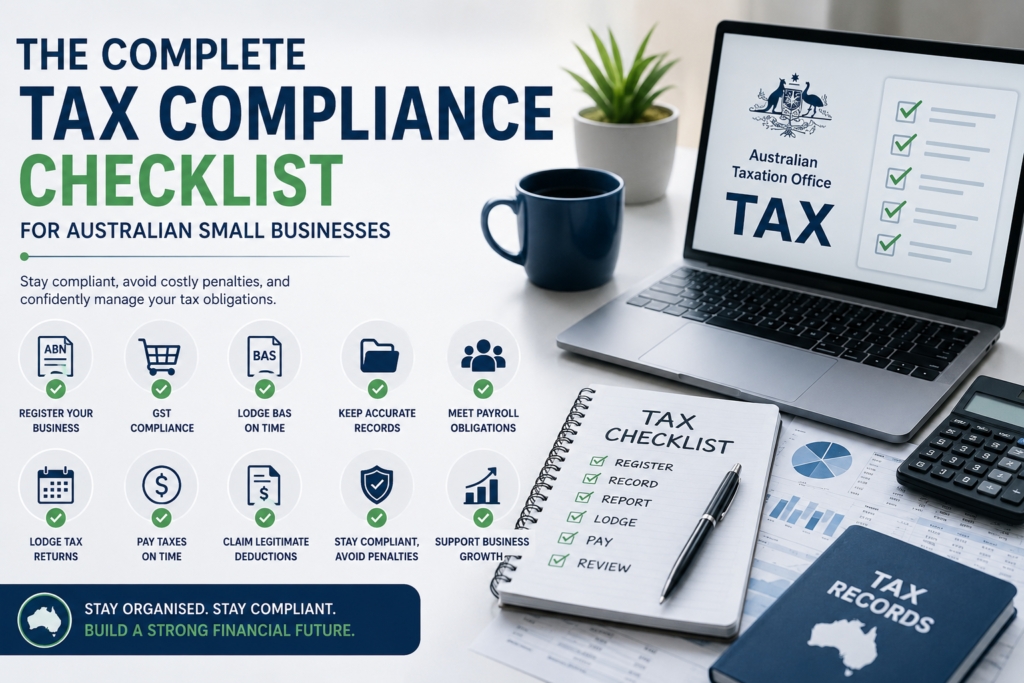
Stay compliant, avoid costly penalties, and confidently manage your business tax obligations in Australia.
Running a successful business in Australia means more than generating revenue, it also means meeting your tax obligations accurately and on time. Whether you’re a sole trader, partnership, trust, or company, maintaining tax compliance is essential for protecting your business, avoiding Australian Taxation Office (ATO) penalties, and building a strong financial foundation for future growth.
Unfortunately, many small businesses fall behind because they don’t fully understand changing tax regulations, GST obligations, payroll requirements, or company tax responsibilities. Missing a deadline, failing to keep proper records, or lodging incorrect returns can result in unnecessary fines, interest charges, and increased scrutiny from the ATO.
That’s why having a practical tax compliance checklist is one of the best ways to stay organised throughout the financial year.
In this guide, you’ll learn:
- What tax compliance means for Australian businesses
- The essential tax obligations every business owner should know
- A step-by-step tax compliance checklist
- Common compliance mistakes to avoid
- When to seek professional tax advisory services
- How expert tax consultants can help your business remain compliant while improving tax efficiency
What Is Tax Compliance?
Tax compliance refers to meeting all taxation obligations required by Australian law. This includes registering for the correct taxes, maintaining accurate financial records, lodging returns on time, paying taxes when due, and complying with reporting requirements set by the Australian Taxation Office (ATO).
For small businesses, tax compliance isn’t just about paying tax, it’s about establishing reliable financial systems that support long-term business growth.
A compliant business typically:
- Registers for all required tax obligations
- Keeps accurate accounting records
- Reports income correctly
- Claims legitimate business deductions
- Meets GST reporting obligations
- Lodges Business Activity Statements (BAS) on time
- Pays employee superannuation correctly
- Completes company tax returns before due dates
- Maintains documentation supporting every financial transaction
Strong tax compliance also makes it easier to secure finance, attract investors, prepare for audits, and make informed business decisions.
Why Tax Compliance Matters for Australian Small Businesses?
Many business owners think about tax only when it’s time to lodge a return. In reality, tax compliance is an ongoing responsibility that affects every aspect of your business.
Remaining compliant helps you:
- Avoid ATO penalties and interest charges
- Improve financial reporting accuracy
- Maintain healthy cash flow
- Reduce audit risks
- Build credibility with lenders and investors
- Make better business decisions using reliable financial data
- Prepare for business growth, acquisitions, or future investment
Businesses with strong financial management are also better positioned to implement effective corporate tax planning, identify legitimate tax-saving opportunities, and improve overall profitability.
Understanding Your Business Tax Obligations in Australia
Every Australian business has different obligations depending on its structure, annual turnover, industry, and number of employees.
Your responsibilities may include:
- Australian Business Number (ABN)
- Tax File Number (TFN)
- Goods and Services Tax (GST)
- Business Activity Statements (BAS)
- Pay As You Go (PAYG) withholding
- Superannuation contributions
- Payroll tax (where applicable)
- Fringe Benefits Tax (FBT)
- Company income tax
- Record keeping requirements
Understanding which obligations apply to your business is the first step toward maintaining effective business tax compliance.
The Complete Tax Compliance Checklist for Australian Small Businesses
1. Register Your Business Correctly
Before you can meet your tax obligations, ensure your business is properly registered with the Australian Government.
Depending on your business structure, you may need:
- Australian Business Number (ABN)
- Tax File Number (TFN)
- Company registration with ASIC
- GST registration
- PAYG withholding registration
Choosing the right business structure, whether you’re a sole trader, partnership, trust, or company—can significantly affect your business tax obligations and future tax planning opportunities.
Starting with the correct setup makes ongoing tax compliance much easier.
2. Register for GST (If Required)
One of the most important aspects of GST compliance is understanding when your business must register.
Generally, businesses with an annual GST turnover of $75,000 or more are required to register for Goods and Services Tax (GST).
Once registered, you’ll need to:
- Charge GST where applicable
- Issue compliant tax invoices
- Track GST collected and paid
- Lodge Business Activity Statements (BAS)
- Keep GST records
Even businesses below the threshold may choose to register voluntarily if it benefits their operations.
Maintaining strong GST compliance helps avoid reporting errors and unnecessary penalties.
3. Keep Accurate Financial Records
Good bookkeeping forms the foundation of successful tax and compliance management.
Maintain accurate records of:
- Sales and revenue
- Business expenses
- Payroll
- Bank transactions
- Asset purchases
- Supplier invoices
- Customer invoices
- Loan agreements
The Australian Taxation Office expects businesses to retain financial records for several years, making organised record-keeping essential.
Using cloud accounting software can simplify compliance while reducing administrative workload.
4. Lodge Your Business Activity Statements (BAS) on Time
If you’re registered for GST, you’ll usually need to lodge BAS either monthly, quarterly, or annually.
Your BAS reports typically include:
- GST collected
- GST credits
- PAYG withholding
- PAYG instalments
Late BAS lodgements may result in penalties and interest charges.
Establishing a recurring compliance calendar helps ensure important deadlines aren’t missed.
5. Monitor Your Business Tax Obligations Throughout the Year
Many businesses only think about tax at the end of the financial year.
Instead, review your business tax position regularly.
Monitor:
- Business income
- Deductible expenses
- Cash flow
- Profitability
- Estimated tax liabilities
Regular reviews help avoid unexpected tax bills while improving financial decision-making.
6. Prepare for Your Corporate Tax Return
If your business operates as a company, lodging an accurate corporate tax return is a key compliance requirement.
Before preparing your return, ensure you have:
- Up-to-date financial statements
- Profit and loss reports
- Balance sheet
- Asset register
- Depreciation schedules
- Payroll records
- Tax adjustment calculations
Well-prepared financial information makes company tax reporting faster and more accurate.
7. Review Your Corporate Tax Position
Effective corporate tax management isn’t about avoiding tax, it’s about ensuring your business complies with legislation while taking advantage of legitimate deductions and concessions.
Regular reviews can help identify:
- Available deductions
- Tax offsets
- Capital allowance opportunities
- Small business concessions
- Timing differences
- Cash flow improvements
This proactive approach supports both compliance and long-term business growth.
8. Meet Employee Tax Obligations
Businesses with employees have additional compliance responsibilities.
These include:
- PAYG withholding
- Superannuation contributions
- Single Touch Payroll (STP) reporting
- Employee payment summaries (where applicable)
- Payroll record maintenance
Missing payroll obligations may result in significant penalties.
Review payroll compliance regularly throughout the year rather than waiting until year-end.
9. Separate Personal and Business Finances
One of the most common compliance mistakes is mixing personal and business expenses.
Maintaining separate business bank accounts helps:
- Improve bookkeeping accuracy
- Simplify tax reporting
- Support deduction claims
- Reduce audit risks
- Improve financial reporting
Clear financial separation makes business accounting and taxation significantly easier to manage.
10. Keep Supporting Documentation
Every tax deduction should be supported by appropriate documentation.
Examples include:
- Tax invoices
- Supplier receipts
- Contracts
- Loan agreements
- Vehicle logbooks
- Travel records
- Asset purchase documentation
Keeping digital copies ensures information remains accessible if requested during an ATO review or audit.
11. Review Your Tax Position Before the End of the Financial Year
Rather than waiting until tax season, conduct a year-end tax review before 30 June.
A proactive review helps identify opportunities for:
- Legitimate deductions
- Asset purchases
- Bad debt write-offs
- Superannuation contributions
- Timing of income and expenses
This is where corporate tax planning becomes particularly valuable, allowing businesses to legally improve tax outcomes while remaining fully compliant.
12. Work with Professional Tax Advisors
Australian tax legislation changes regularly.
Working with experienced professionals offering tax advisory services ensures your business stays compliant while identifying opportunities to improve efficiency.
Professional advisors can assist with:
- Tax compliance reviews
- GST compliance
- Business tax planning
- Corporate tax advice
- Company tax returns
- BAS lodgements
- Financial reporting
- ATO correspondence
- Tax risk management
Rather than reacting to tax issues after they occur, experienced advisors help businesses prevent problems before they arise.
13. Conduct Regular Compliance Reviews
Tax compliance should be treated as an ongoing business process, not a once-a-year activity.
Quarterly or monthly reviews allow you to identify potential issues early and maintain confidence that your business is meeting all reporting obligations.
Regular reviews typically include:
- Financial statement reconciliation
- GST reporting checks
- Payroll verification
- Expense reviews
- Tax payment forecasting
- Compliance deadline monitoring
Businesses that perform routine compliance reviews are generally better prepared for audits and financial growth opportunities.
Common Tax Compliance Mistakes Small Businesses Should Avoid
Even well-managed businesses can make tax compliance mistakes that lead to unnecessary costs, penalties, or increased attention from the Australian Taxation Office (ATO). Understanding these common issues can help you strengthen your compliance processes and avoid costly errors.
Missing Tax Lodgement Deadlines
Late lodgement of Business Activity Statements (BAS), company tax returns, or other tax obligations can result in penalties and interest charges.
Creating a tax calendar with key lodgement dates ensures your business stays on track throughout the year.
Poor Record Keeping
Many businesses fail to maintain complete financial records, making it difficult to support tax deductions or prepare accurate returns.
Keep records of:
- Sales invoices
- Purchase invoices
- Bank statements
- Payroll records
- Asset purchases
- Loan agreements
- Business expenses
Digital record-keeping systems can significantly improve accuracy and efficiency.
Incorrect GST Reporting
Errors in GST calculations or reporting are among the most common compliance issues for Australian businesses.
Regularly reconciling GST collected against GST paid helps reduce mistakes and improves overall GST compliance.
Mixing Personal and Business Expenses
Using the same bank account for personal and business transactions often creates reporting issues and increases bookkeeping complexity.
Separate accounts improve financial reporting and simplify tax preparation.
Claiming Ineligible Deductions
Businesses sometimes claim expenses that are not deductible or fail to keep sufficient supporting documentation.
Before claiming deductions, ensure each expense is:
- Directly related to business activities
- Properly documented
- Allowed under Australian tax legislation
Ignoring Changes to Tax Legislation
Australian tax rules evolve regularly. Staying informed about legislative updates helps businesses remain compliant and identify new opportunities for tax efficiency.
Working with experienced professionals offering tax advisory services ensures your business keeps pace with changing requirements.
How Professional Tax Advisory Services Help Your Business
Tax compliance is only one part of effective financial management.
Professional tax advisory services help businesses move beyond compliance by providing strategic advice that supports sustainable growth.
A qualified advisor can assist with:
- Business tax planning
- Corporate tax planning
- GST compliance reviews
- Tax risk management
- Company tax returns
- Business restructuring
- Cash flow planning
- Tax-efficient business structures
- ATO communication and support
Rather than responding to tax issues after they arise, proactive tax advice helps prevent problems while identifying opportunities to improve business performance.
When Should You Work with a Tax Consultant?
Many business owners wait until tax season before contacting a professional.
In reality, a qualified tax consultant can add value throughout the year.
You should consider seeking professional advice if you are:
- Starting a new business
- Registering for GST
- Hiring your first employees
- Growing rapidly
- Expanding into new markets
- Purchasing another business
- Selling your business
- Restructuring your company
- Facing an ATO review or audit
- Looking to improve cash flow through better tax planning
Ongoing support often leads to better financial outcomes than relying solely on year-end tax preparation.
Why Choose Vertex Growth?
At Vertex Growth, we understand that effective tax compliance goes beyond meeting deadlines.
Our team works with Australian businesses to build practical financial systems that reduce risk, improve reporting accuracy, and support long-term growth.
Our tax services include:
- Tax compliance reviews
- Business tax advisory
- GST compliance support
- Corporate tax planning
- Company tax return preparation
- Business Activity Statement (BAS) assistance
- Financial reporting
- Business advisory
- Cash flow planning
- Ongoing tax consulting services
Whether you’re a growing startup, family-owned business, or established company, we provide practical advice tailored to your business objectives.
Frequently Asked Questions
What is tax compliance?
Tax compliance is the process of meeting all legal tax obligations, including registering for relevant taxes, maintaining accurate financial records, lodging tax returns on time, and paying taxes when due.
Who needs to register for GST in Australia?
Generally, businesses with an annual GST turnover of $75,000 or more must register for GST. Some businesses below this threshold may choose to register voluntarily.
What is the difference between business tax and corporate tax?
Business tax refers to the various taxes a business may be required to pay, while corporate tax specifically applies to companies on their taxable income.
What happens if I miss a tax lodgement deadline?
Late lodgements can result in penalties, interest charges, and increased scrutiny from the Australian Taxation Office (ATO).
How long should I keep tax records?
Most Australian businesses should retain tax and financial records for at least five years. Keeping digital copies makes retrieval easier if required.
Why is GST compliance important?
Accurate GST reporting helps businesses avoid penalties, maintain reliable financial records, and ensure Business Activity Statements are completed correctly.
What is corporate tax planning?
Corporate tax planning involves organising your business affairs in a legal and commercially sound way to manage tax obligations efficiently while remaining fully compliant.
Do small businesses need professional tax advisory services?
Many small businesses benefit from professional advice because tax legislation changes regularly. Advisors help reduce compliance risks while identifying legitimate opportunities to improve tax outcomes.
Final Thoughts
Maintaining tax compliance isn’t simply about avoiding penalties, it’s about building a financially healthy, well-managed business.
By following a structured compliance process, keeping accurate records, meeting reporting obligations, and reviewing your tax position throughout the year, you can reduce risk and make better financial decisions.
As your business grows, tax obligations become more complex. Seeking expert guidance can help you stay compliant while creating opportunities to improve profitability and support long-term success.
Need Expert Tax Compliance Support?
Whether you need assistance with GST compliance, business tax, corporate tax returns, or ongoing tax advisory services, Vertex Growth is here to help.
Our experienced advisors work closely with Australian businesses to simplify tax compliance, improve financial reporting, and provide practical advice that supports sustainable growth.
Contact Vertex Growth today to discuss your tax compliance requirements and discover how our experienced team can help your business remain compliant while planning for the future.