
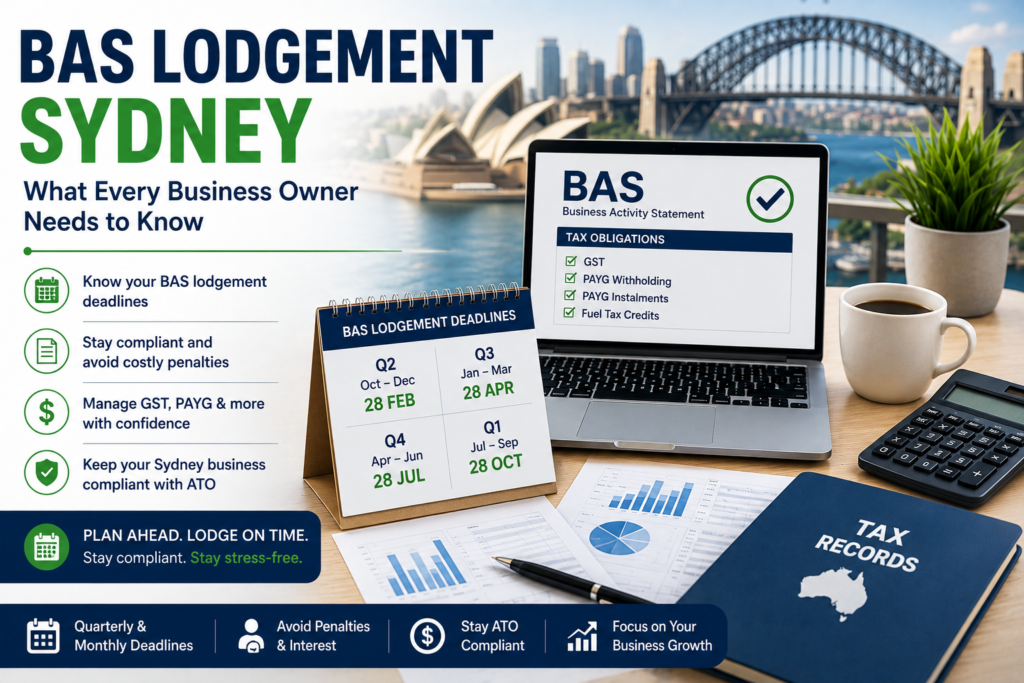
If you’re running a business in Sydney, staying on top of your tax obligations is just as important as managing your customers, employees, and cash flow. One of the most important compliance requirements for GST-registered businesses is lodging your Business Activity Statement (BAS) on time. Missing a deadline can lead to penalties, interest charges, and unnecessary stress.
Whether you’re a sole trader, startup, tradie, retailer, café owner, or growing company, understanding BAS lodgement Sydney requirements for 2026 can help you avoid costly mistakes and keep your business compliant with the Australian Taxation Office (ATO).
In this guide, we’ll explain everything you need to know about BAS lodgement deadlines for 2026, who needs to lodge, the different reporting cycles, important due dates, and practical tips to help your Sydney business stay organised throughout the year.
What Is a BAS?
A Business Activity Statement (BAS) is a form issued by the Australian Taxation Office (ATO) that businesses use to report and pay various tax obligations.
Depending on your business, your BAS may include:
- Goods and Services Tax (GST)
- PAYG withholding
- PAYG instalments
- Luxury Car Tax (if applicable)
- Wine Equalisation Tax (if applicable)
- Fuel Tax Credits
Most small businesses primarily use their BAS to report GST collected from customers and GST paid on eligible business expenses. The ATO uses this information to determine whether you need to make a payment or receive a refund.
Why BAS Lodgement Matters for Sydney Businesses?
For many Sydney businesses, BAS lodgement isn’t just another administrative task, it’s a critical part of maintaining financial health and legal compliance.
Lodging your BAS accurately and on time helps you:
- Stay compliant with ATO requirements
- Avoid Failure to Lodge (FTL) penalties
- Minimise General Interest Charges (GIC) on unpaid amounts
- Maintain accurate financial records
- Improve cash flow forecasting
- Reduce the likelihood of ATO audits
Sydney businesses often experience seasonal fluctuations, especially in industries such as hospitality, construction, retail, and professional services. Keeping your BAS up to date provides a clearer picture of your business’s financial performance while helping you plan ahead for tax payments.
Who Needs to Lodge a BAS?
Generally, you’ll need to lodge a BAS if your business is registered for GST.
GST registration is compulsory if your annual GST turnover reaches the required threshold. Even businesses below the threshold may choose to register voluntarily if it benefits their operations.
Businesses commonly required to lodge BAS include:
- Sole traders
- Partnerships
- Companies
- Trusts
- Cafés and restaurants
- Retail stores
- Construction businesses
- Professional service providers
- E-commerce businesses
- Medical and allied health practices
If you’re unsure about your reporting obligations, working with an experienced BAS professional can ensure you’re meeting all ATO requirements correctly.
BAS Lodgement Deadlines for 2026
One of the most common reasons businesses incur penalties is simply missing a lodgement deadline.
Your due dates depend on whether you lodge your BAS monthly, quarterly, or annually.
Most small businesses report quarterly, while larger businesses generally lodge monthly.
Quarterly BAS Due Dates (Most Small Businesses)
The majority of Australian small businesses lodge their BAS every quarter.
| Reporting Quarter | Period Covered | Standard Due Date |
| Q2 2025–26 | October – December 2025 | 28 February 2026 |
| Q3 2025–26 | January – March 2026 | 28 April 2026 |
| Q4 2025–26 | April – June 2026 | 28 July 2026 |
| Q1 2026–27 | July – September 2026 | 28 October 2026 |
Businesses lodging electronically may receive an online lodgement extension for certain quarters, while registered BAS or tax agents may receive additional concession dates under the ATO’s lodgement program.
Monthly BAS Due Dates
Businesses with an annual GST turnover of $20 million or more are generally required to lodge BAS every month.
Monthly BAS is typically due on the 21st day of the following month.
For example:
| Activity Month | Due Date |
| January 2026 | 21 February 2026 |
| February 2026 | 21 March 2026* |
| March 2026 | 21 April 2026 |
| April 2026 | 21 May 2026 |
| May 2026 | 21 June 2026 |
| June 2026 | 21 July 2026 |
*If a due date falls on a weekend or public holiday, the ATO generally moves it to the next business day.
Do Registered BAS Agents Get Extra Time?
Yes. One of the biggest advantages of working with a registered BAS or tax agent is access to the ATO’s lodgement concession program.
For eligible businesses, agent lodgement dates are typically extended for several quarterly reporting periods.
For the 2025–26 reporting year, common agent concession dates include:
| Quarter | Standard Due Date | Registered Agent Due Date |
| Q1 | 28 October 2025 | 25 November 2025 |
| Q2 | 28 February 2026 | No additional extension |
| Q3 | 28 April 2026 | 26 May 2026 |
| Q4 | 28 July 2026 | 25 August 2026 |
These extensions can provide valuable breathing room for Sydney businesses, especially during busy trading periods or the end of the financial year. Eligibility depends on meeting the ATO’s requirements and engaging a registered BAS or tax agent before the relevant reporting period ends.
What Happens If You Miss a BAS Deadline?
Missing a BAS deadline doesn’t just create extra paperwork, it can become an expensive mistake.
Depending on your circumstances, the ATO may apply:
- Failure to Lodge (FTL) penalties
- General Interest Charges (GIC) on unpaid amounts
- Additional compliance reviews
- Increased scrutiny of future lodgements
The longer your BAS remains overdue, the more penalties and interest may accumulate. Even if you’re unable to pay the full amount owing, it’s generally better to lodge your BAS on time and discuss payment options with the ATO rather than delaying your lodgement.
Why Sydney Businesses Shouldn’t Leave BAS Until the Last Minute?
Many business owners wait until the week their BAS is due before gathering invoices, reconciling bank accounts, and reviewing expenses. This often leads to rushed calculations, overlooked deductions, and avoidable errors.
Preparing your BAS throughout the quarter offers several advantages:
- More accurate financial reporting
- Better visibility of GST obligations
- Improved cash flow planning
- Less stress before due dates
- Faster lodgement process
- Reduced risk of mistakes
Using cloud accounting software and maintaining up-to-date bookkeeping records can make BAS preparation significantly easier, particularly for growing Sydney businesses with high transaction volumes.
Common BAS Lodgement Mistakes Sydney Businesses Should Avoid
Even experienced business owners can make mistakes when preparing and lodging their Business Activity Statement. While some errors are minor, others can result in penalties, delays, or incorrect GST reporting.
Here are some of the most common BAS mistakes and how to avoid them.
1. Missing Lodgement Deadlines
One of the biggest mistakes businesses make is simply forgetting the due date. Busy periods, staff shortages, or poor record-keeping can easily push BAS preparation to the bottom of the priority list.
How to avoid it:
- Add BAS due dates to your business calendar.
- Set reminders at least two weeks before each deadline.
- Work with a registered BAS agent who can help manage your lodgement schedule.
2. Claiming GST on Ineligible Expenses
Not every business expense includes claimable GST. Claiming GST credits incorrectly can lead to amended BAS statements and potential ATO reviews.
Examples of expenses that may not include GST include:
- Bank fees
- Certain financial services
- Some insurance products
- GST-free items
Always check your tax invoices and consult a BAS professional if you’re unsure.
3. Poor Record Keeping
Accurate bookkeeping is the foundation of correct BAS reporting. Missing invoices, duplicate transactions, or unreconciled bank accounts can result in inaccurate GST calculations.
Good record-keeping practices include:
- Keeping digital copies of receipts and invoices
- Reconciling bank accounts regularly
- Recording expenses throughout the quarter
- Using cloud accounting software
4. Mixing Business and Personal Expenses
Using the same bank account for both business and personal spending makes BAS preparation much more complicated.
Separate accounts help you:
- Track deductible expenses accurately
- Reduce bookkeeping errors
- Simplify GST reporting
- Save time during BAS preparation
5. Waiting Until the Last Minute
Preparing your BAS a day or two before it’s due increases the likelihood of mistakes and unnecessary stress.
Instead, update your financial records weekly or monthly so that your BAS is largely complete before the end of each reporting period.
Tips to Make BAS Lodgement Easier
Staying compliant doesn’t have to be difficult. A few simple habits can make BAS preparation faster, more accurate, and less stressful.
Keep Your Bookkeeping Up to Date
Regular bookkeeping means you’ll spend less time searching for receipts or correcting errors when BAS is due.
Rather than leaving everything until the end of the quarter, schedule weekly bookkeeping sessions to keep your records current.
Use Cloud Accounting Software
Modern accounting platforms can automate many aspects of BAS preparation, including:
- GST tracking
- Invoice management
- Expense categorisation
- Bank reconciliation
- Financial reporting
These tools reduce manual data entry and improve reporting accuracy.
Monitor Your Cash Flow
Remember that GST collected from customers doesn’t belong to your business—it needs to be paid to the ATO.
Setting aside GST funds throughout the quarter can help you avoid cash flow problems when your BAS payment is due.
Review Your BAS Before Lodging
Before submitting your BAS, double-check:
- GST collected
- GST credits claimed
- Payroll figures
- PAYG withholding
- Supporting documentation
A quick review can prevent costly mistakes and save time later.
Why Work with a BAS Professional?
Many Sydney business owners initially handle BAS themselves, but as their businesses grow, reporting becomes more complex.
A registered BAS professional can provide valuable support by:
- Preparing and lodging BAS accurately
- Identifying eligible GST credits
- Reducing compliance risks
- Keeping track of important lodgement dates
- Assisting with ATO correspondence
- Helping improve bookkeeping processes
Beyond compliance, professional BAS services can also provide insights into your business’s financial performance, helping you make informed decisions throughout the year.
For many businesses, outsourcing BAS preparation saves time, reduces stress, and allows owners to focus on growing their business rather than managing paperwork.
Why Choose Our BAS Lodgement Services in Sydney?
Managing BAS obligations doesn’t need to be overwhelming when you have the right support.
Our experienced team helps Sydney businesses stay compliant by providing accurate, reliable, and timely BAS lodgement services tailored to businesses of all sizes.
When you work with us, you benefit from:
- Accurate BAS preparation and lodgement
- Ongoing compliance support
- Up-to-date knowledge of ATO requirements
- Assistance with GST reporting
- Professional bookkeeping guidance
- Timely reminders to help you avoid missed deadlines
- Personalised advice based on your business needs
Whether you’re a sole trader, small business, or growing company, we make BAS lodgement Sydney simple, efficient, and stress-free.
Get Professional BAS Lodgement Support
Don’t risk late lodgements or costly reporting mistakes. Our experienced team can help you prepare, review, and lodge your BAS accurately and on time, giving you peace of mind and more time to focus on running your business.
Contact us today to learn how our BAS lodgement Sydney services can help keep your business compliant all year round.
Conclusion
Meeting your BAS obligations is an essential part of running a successful business. Staying on top of lodgement deadlines, maintaining accurate financial records, and understanding your GST responsibilities can help you avoid penalties while improving your overall financial management.
Whether you lodge monthly or quarterly, planning ahead and keeping your bookkeeping up to date will make the BAS process much easier. As your business grows, working with experienced professionals can save valuable time, reduce compliance risks, and ensure every lodgement is completed accurately.
If you’re looking for reliable BAS lodgement Sydney services, our team is here to help. From bookkeeping support to accurate BAS preparation and timely lodgements, we provide practical solutions that help Sydney businesses stay compliant and focus on what matters most, growing their business.
Frequently Asked Questions (FAQs)
1. What is BAS lodgement?
BAS lodgement is the process of submitting your Business Activity Statement to the Australian Taxation Office (ATO). It reports obligations such as GST, PAYG withholding, PAYG instalments, and other applicable business taxes.
2. Who needs to lodge a BAS in Australia?
Businesses registered for GST are generally required to lodge a BAS. Depending on the size and structure of your business, you may need to lodge monthly, quarterly, or annually.
3. What are the BAS lodgement deadlines for 2026?
Most small businesses lodge quarterly, with standard due dates including 28 February, 28 April, 28 July, and 28 October, depending on the reporting period. Businesses lodging through registered BAS agents may qualify for extended due dates under the ATO’s lodgement program.
4. Can I lodge my BAS online?
Yes. You can lodge your BAS online using the ATO’s online services, compatible accounting software, or through a registered BAS or tax agent.
5. What happens if I lodge my BAS late?
Late BAS lodgements may result in Failure to Lodge (FTL) penalties, General Interest Charges (GIC), and additional compliance action from the ATO. Lodging on time, even if you cannot pay immediately, is generally the better option.
6. Should I use a BAS agent?
A registered BAS agent can help ensure your BAS is prepared accurately, lodged on time, and compliant with ATO requirements. They may also provide access to eligible lodgement extensions and assist with GST reporting.
7. How can I make BAS lodgement easier?
Maintaining accurate bookkeeping records, using cloud accounting software, reconciling your accounts regularly, and preparing throughout the reporting period can significantly simplify BAS lodgement.
8. What records should I keep for BAS reporting?
You should keep tax invoices, receipts, bank statements, payroll records, expense documentation, and GST records. Maintaining organised financial records helps ensure accurate BAS reporting and supports your claims if requested by the ATO.
9. Can I correct a mistake after lodging my BAS?
Yes. If you discover an error after submitting your BAS, you may be able to correct it in a later BAS or request an amendment, depending on the type and size of the mistake. Seeking professional advice can help determine the appropriate correction process.
10. Why choose professional BAS lodgement services in Sydney?
Professional BAS lodgement Sydney services help reduce errors, improve compliance, save time, and ensure your business meets all ATO reporting obligations. They also provide expert guidance, helping you manage your tax responsibilities with greater confidence.