
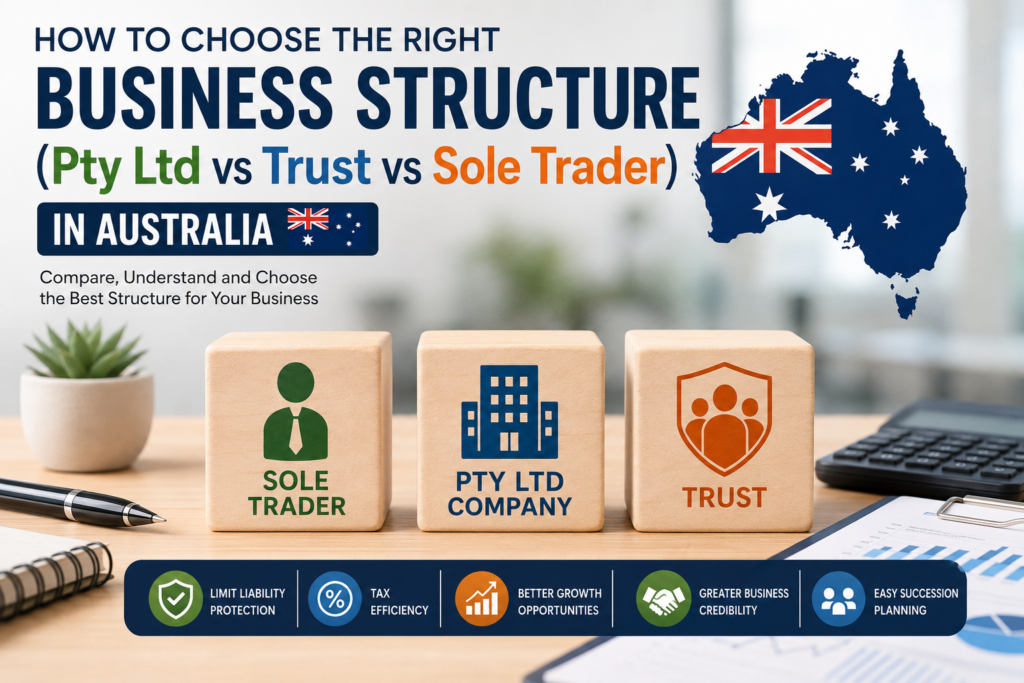
Starting a business is an exciting journey, but one of the first and most important decisions you’ll make is choosing the right business structure in Australia. Your business structure impacts everything, from taxes and legal obligations to personal liability, funding opportunities, and future growth.
Many entrepreneurs start as a sole trader because it’s simple and inexpensive. Others choose a Pty Ltd company for better legal protection and credibility, while some business owners establish a trust to gain tax flexibility and safeguard family wealth.
So, how do you know which structure is right for you?
In this guide, we’ll compare the three most common Australian business structures, Sole Trader, Pty Ltd Company, and Trust, to help you make an informed decision. Whether you’re launching a startup, freelancing, opening a retail store, or building a long-term investment business, this article will explain the pros, cons, costs, and ideal use cases for each option.
By the end, you’ll have a clear understanding of the best structure for your business goals.
Why Choosing the Right Business Structure Matters?
Many new business owners focus on branding, marketing, and attracting customers, but overlook the legal foundation of their business. Your chosen structure influences almost every aspect of how your business operates.
Selecting the wrong structure can lead to:
- Paying more tax than necessary
- Being personally liable for business debts
- Difficulty attracting investors
- Higher compliance costs
- Complicated ownership transfers
- Limited business growth opportunities
On the other hand, choosing the right business structure in Australia provides several advantages, including:
- Better asset protection
- Tax efficiency
- Easier business expansion
- Greater credibility with clients and lenders
- Improved succession planning
That’s why it’s worth taking the time to evaluate your options before registering your business.
Overview of Business Structures in Australia
Australia offers several business structures, but three are the most common for small and medium-sized businesses:
| Business Structure | Best For | Liability | Tax |
| Sole Trader | Freelancers, consultants, small businesses | Unlimited | Personal income tax |
| Pty Ltd Company | Growing businesses and startups | Limited | Company tax rate |
| Trust | Family businesses and investments | Depends on trustee | Distributed to beneficiaries |
Each structure has its own advantages and disadvantages. Let’s look at them individually.
Sole Trader
A sole trader is the simplest and most affordable business structure in Australia. One person owns and operates the business, making all decisions while keeping all profits.
Many Australians begin their entrepreneurial journey as sole traders because registration is straightforward and compliance requirements are minimal.
Advantages of a Sole Trader
Easy and Affordable Setup
Starting as a sole trader usually requires:
- Registering an ABN
- Registering a business name (if needed)
- Meeting GST obligations if applicable
There are fewer legal requirements compared to companies or trusts, making it ideal for first-time entrepreneurs.
Full Control
As the sole owner, you have complete authority over business decisions.
There is no need to consult directors, shareholders, or trustees before making strategic choices.
Lower Compliance Costs
Sole traders generally don’t have to:
- Lodge company annual reviews
- Prepare extensive corporate reports
- Maintain company registers
This keeps accounting and administration costs relatively low.
Simple Tax Reporting
Business income is reported as part of your personal tax return, making tax management easier for many small businesses.
Disadvantages of a Sole Trader
Unlimited Personal Liability
This is the biggest drawback.
Because the business and owner are legally the same entity, you’re personally responsible for:
- Business loans
- Debts
- Legal claims
- Financial losses
If the business fails, personal assets such as your home or savings could potentially be at risk.
Harder to Raise Capital
Banks and investors generally prefer companies over sole traders because companies offer a more structured ownership model.
This can make business expansion more challenging.
Limited Growth Potential
While many successful businesses begin as sole traders, expanding often requires transitioning to a company structure to improve scalability and attract investment.
Who Should Choose a Sole Trader?
A sole trader structure is usually suitable if you:
- Are a freelancer
- Work as a consultant
- Run a small online business
- Operate with low financial risk
- Want minimal startup costs
- Are testing a new business idea
For many new entrepreneurs, starting as a sole trader allows them to validate their business before moving to a more complex structure.
Pty Ltd Company
A Proprietary Limited (Pty Ltd) Company is a separate legal entity from its owners.
Unlike a sole trader, the company itself owns the business assets, enters contracts, and takes on liabilities.
This separation offers significant legal and financial protection, making the Pty Ltd structure one of the most popular choices for growing Australian businesses.
Advantages of a Pty Ltd Company
Limited Liability Protection
One of the biggest benefits is limited liability.
Generally, shareholders are only responsible for the amount invested in the company.
If the business experiences financial difficulties, personal assets are usually protected, provided directors have complied with their legal obligations.
This makes a Pty Ltd company an attractive option for businesses with higher levels of financial or legal risk.
Increased Business Credibility
Many customers, suppliers, and financial institutions view Pty Ltd companies as more established and trustworthy than sole traders.
Having “Pty Ltd” in your business name can improve confidence when:
- Applying for business finance
- Negotiating supplier agreements
- Working with larger corporate clients
- Bidding for government contracts
For businesses planning significant growth, credibility can become a valuable competitive advantage.
Easier Access to Investment
Companies can issue shares to attract investors and raise capital.
This flexibility makes the Pty Ltd structure suitable for startups with ambitious growth plans, businesses seeking external funding, or organisations preparing for expansion.
Unlike sole traders, ownership can be divided among multiple shareholders, making it easier to bring in business partners or investors.
Business Continuity
A Pty Ltd company continues to exist even if ownership changes.
This makes succession planning, selling the business, or transferring ownership significantly easier than with a sole trader structure.
The business isn’t tied to a single individual, allowing for long-term stability and continuity.
Trust
A trust is a legal arrangement where a trustee manages assets or a business on behalf of beneficiaries. Trusts are commonly used in Australia for family businesses, property investments, and asset protection strategies.
Unlike a sole trader or a company, a trust is not a separate legal entity. Instead, the trustee (which can be an individual or a company) is responsible for managing the trust according to the trust deed.
While trusts are more complex to establish and administer, they can offer significant tax planning and asset protection benefits when used appropriately.
Advantages of a Trust
Tax Flexibility
One of the biggest advantages of a trust is the ability to distribute income to beneficiaries.
Depending on the trust deed and current tax laws, income can often be allocated among eligible beneficiaries in a tax-efficient way. This flexibility can help families legally manage their overall tax position.
Asset Protection
Trusts can provide a higher level of asset protection than sole trader structures.
Because trust assets are generally held by the trustee for the benefit of beneficiaries, they may be better protected from certain personal financial risks. However, the level of protection depends on how the trust is structured and operated.
Succession Planning
Trusts are often used for long-term wealth management because they can make it easier to transfer wealth across generations without changing ownership of underlying assets.
This makes them a popular option for family-owned businesses and investment portfolios.
Disadvantages of a Trust
Higher Setup and Ongoing Costs
Compared to a sole trader, trusts are more expensive to establish and maintain.
Typical costs include:
- Trust deed preparation
- Accounting fees
- Annual tax returns
- Professional legal advice
- Ongoing administration
Complex Compliance
Trusts have more legal and taxation obligations than sole traders.
Business owners often require ongoing advice from an accountant or lawyer to ensure compliance and maximise available benefits.
Not Ideal for Every Small Business
If you’re running a simple freelance business or testing a new business idea, a trust may introduce unnecessary complexity and costs.
Who Should Choose a Trust?
A trust may be suitable if you:
- Operate a family business
- Own significant business or investment assets
- Want greater flexibility in distributing income
- Need long-term succession planning
- Are seeking enhanced asset protection
Pty Ltd vs Trust vs Sole Trader: Comparison Table
| Feature | Sole Trader | Pty Ltd Company | Trust |
| Setup Cost | Low | Moderate | High |
| Ongoing Compliance | Low | Medium | High |
| Legal Entity | No | Yes | No (trustee acts on behalf of the trust) |
| Personal Liability | Unlimited | Limited | Depends on trustee structure |
| Tax Treatment | Personal income tax | Company tax rate | Income distributed to beneficiaries |
| Asset Protection | Low | High | High (subject to structure) |
| Raising Investment | Difficult | Easier | Limited |
| Business Continuity | Ends with owner unless transferred | Continues independently | Can continue through trustee arrangements |
| Best For | Freelancers and small businesses | Growing businesses and startups | Family businesses and wealth management |
How to Choose the Right Business Structure in Australia
There is no one-size-fits-all answer when it comes to choosing the right business structure in Australia. The best option depends on your goals, level of risk, expected income, and future growth plans.
Consider the following questions before making your decision.
1. What Level of Risk Does Your Business Have?
If your business operates in an industry where legal claims or significant debts are possible, a Pty Ltd company generally offers stronger personal asset protection than operating as a sole trader.
Low-risk service businesses may find a sole trader structure sufficient during the early stages.
2. How Fast Do You Plan to Grow?
If you intend to:
- Hire employees
- Bring in investors
- Expand nationally
- Sell your business in the future
a Pty Ltd company often provides greater flexibility.
If your business is likely to remain small, a sole trader structure may be easier to manage.
3. What Is Your Budget?
Business structures vary in cost.
Sole Trader
- Lowest setup costs
- Minimal administration
- Lower accounting fees
Pty Ltd Company
- Higher registration costs
- Annual compliance requirements
- Corporate reporting obligations
Trust
- Highest establishment costs
- Professional legal documentation
- Ongoing accounting and administration
Choosing the cheapest option isn’t always the best long-term decision. Consider the total value, not just the initial cost.
4. Do You Need Asset Protection?
If protecting your personal wealth is a priority, operating through a company or a properly structured trust may provide better protection than a sole trader arrangement.
This is particularly important for businesses taking on loans, entering contracts, or operating in higher-risk industries.
5. Are You Looking for Tax Planning Opportunities?
Business owners with growing profits often review their structure to improve tax efficiency.
While tax should never be the only reason to choose a structure, it is an important consideration. A qualified accountant can help determine whether a company or trust is appropriate for your circumstances.
Common Mistakes to Avoid
Choosing the wrong business structure can become expensive later. Here are some common mistakes to avoid.
Starting Without Professional Advice
Every business has different financial and legal requirements. Consulting an accountant or business advisor before registering your structure can save time and money.
Choosing Based Only on Cost
Many entrepreneurs choose a sole trader structure simply because it’s inexpensive.
However, if your business grows quickly, restructuring later may involve additional legal, tax, and administrative costs.
Ignoring Future Growth
Think beyond your first year.
If your long-term goal includes employees, investors, or selling the business, choose a structure that supports those ambitions.
Mixing Personal and Business Finances
Regardless of your structure, always keep business and personal finances separate.
Using dedicated business bank accounts and maintaining accurate financial records makes tax reporting and compliance much easier.
Frequently Asked Questions
Is a Pty Ltd company better than a sole trader?
It depends on your business goals. A Pty Ltd company generally provides limited liability, improved credibility, and greater growth opportunities, while a sole trader structure is simpler and less expensive to operate.
Can I change my business structure later?
Yes. Many Australian businesses start as sole traders and later transition to a Pty Ltd company or another structure as they grow. However, restructuring can involve legal, tax, and administrative implications, so professional advice is recommended.
Is a trust better for tax purposes?
A trust may offer greater flexibility in distributing income to beneficiaries, but whether it results in tax savings depends on your individual circumstances and current tax laws.
Which structure is best for a small business?
For many new businesses, a sole trader structure is a practical starting point because it is easy to establish and manage. Businesses expecting rapid growth, external investment, or higher risk often choose a Pty Ltd company instead.
Final Thoughts
Choosing the right business structure in Australia is one of the most important decisions you’ll make as a business owner. The structure you choose today can influence your taxes, legal responsibilities, personal liability, operating costs, and future growth opportunities.
As a general guide:
- Choose a Sole Trader structure if you’re starting a low-risk business, freelancing, or testing a new idea with minimal setup costs.
- Choose a Pty Ltd Company if you want stronger liability protection, greater credibility, and the flexibility to grow your business.
- Choose a Trust if your priorities include asset protection, family wealth management, or tax planning through income distribution.
There is no universally “best” structure, only the one that best fits your business objectives and circumstances.
Before making a final decision, it’s wise to consult an accountant or legal professional who can provide advice tailored to your specific situation. Investing in the right structure from the beginning can save significant time, money, and complexity as your business grows.
Still unsure about choosing the right business structure in Australia?
Whether you’re launching your first business or restructuring an existing one, professional advice can help you make the right decision with confidence. Speak with an experienced accountant or business advisor to assess your goals, understand your obligations, and select the structure that supports your long-term success.